Islamic Car Financing in Pakistan: Complete Car Finance Guide for 2026
Explore Islamic Car Finance in Pakistan, how Diminishing Musharakah works, costs, benefits, eligibility, and how it compares with conventional financing.
Introduction: Islamic Car Financing in Pakistan: A Smarter Way to Own Your Next Vehicle?
For many Pakistanis, buying a car has become increasingly challenging. Rising vehicle prices, inflation, and limited savings often push buyers toward financing options. Yet for a large segment of the population, the question isn’t just about affordability—it’s about finding a Car Finance solution that aligns with Islamic principles.
This is where Islamic car financing enters the picture.
Over the past decade, Islamic banking has transformed from a niche offering into a major force in Pakistan’s financial sector. Today, nearly every major Islamic bank offers Shariah-compliant vehicle financing products based primarily on the concept of Diminishing Musharakah, a partnership model that differs fundamentally from conventional interest-based lending.
But is Islamic car financing really different? How does it work in practice? Is it more expensive? And most importantly, is it the right option for you?
Let’s take a closer look.
The Rise of Islamic Car Finance in Pakistan
Pakistan has witnessed significant growth in Islamic banking over the last few years. According to industry reports and banking sector data, Islamic finance now represents a substantial share of the country’s banking assets, with continued expansion driven by customer demand for Shariah-compliant financial products.
Vehicle financing has become one of the most popular consumer products within Islamic banking.
Banks such as HBL Islamic, FaysalBank, Meezan Bank, and UBL now offer dedicated Islamic auto financing programs designed for both salaried individuals and business owners.
The popularity of these products stems from a simple reality: many buyers want financing without engaging in conventional interest-based loans.
How Islamic Car Financing Actually Works
The most common structure used by Pakistani banks is Diminishing Musharakah (DM).
Under this arrangement:
- The bank and customer jointly purchase the vehicle.
- Both parties become co-owners.
- The bank leases its ownership share to the customer.
- The customer gradually purchases the bank’s share through monthly payments.
- Once all ownership units are purchased, the customer becomes the sole owner of the vehicle.
A Simple Example
Imagine you want to buy a car worth PKR 3 million.
- You contribute PKR 900,000 (30%).
- The bank contributes PKR 2.1 million (70%).
- The bank’s ownership is divided into units.
- Every month:
- You pay rent for using the bank’s share.
- You purchase a portion of the bank’s ownership.
As your ownership increases, the bank’s share decreases. Eventually, you own 100% of the vehicle.
This gradual transfer of ownership is what gives Diminishing Musharakah its name.
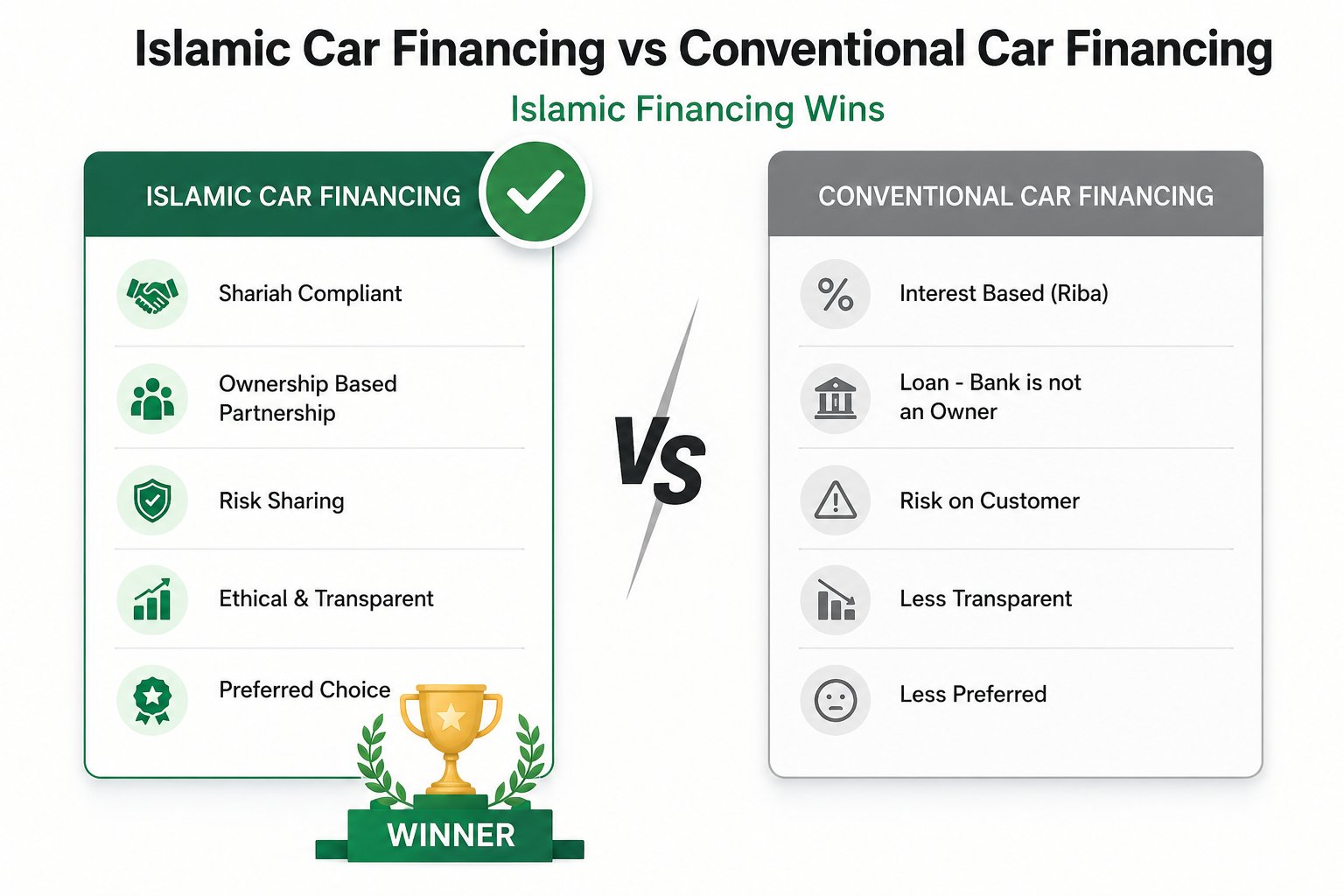
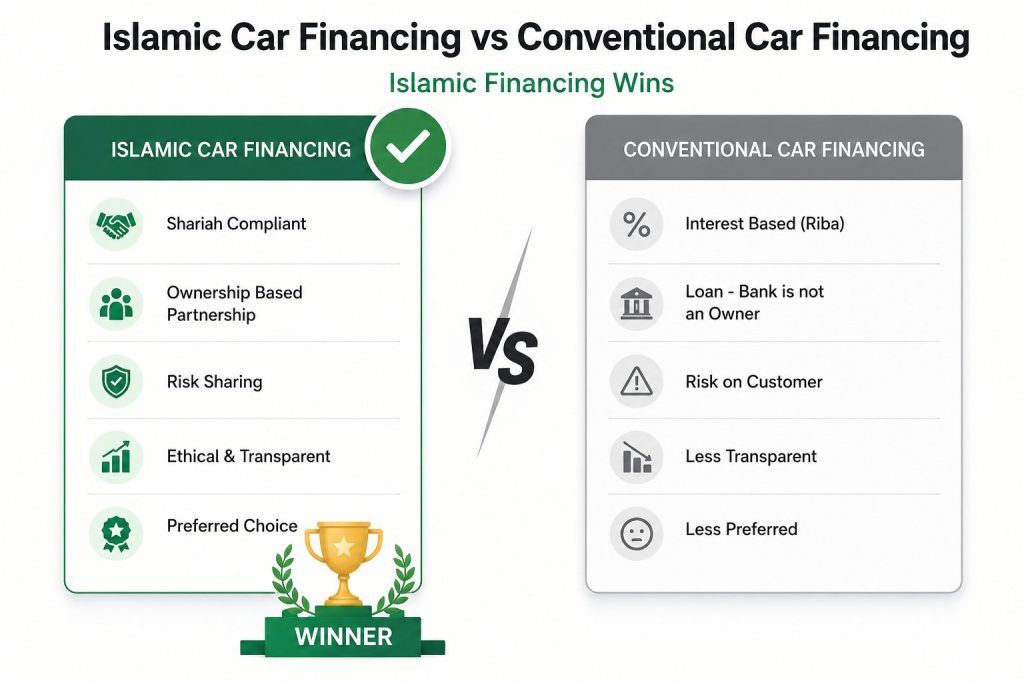
Islamic vs Conventional Car Finance
Many consumers struggle to understand the practical difference between Islamic and conventional financing.
The following comparison simplifies the distinction:
| Feature | Islamic Car Finance | Conventional Car Finance |
|---|---|---|
| Structure | Joint ownership partnership | Loan agreement |
| Bank earns through | Rental + asset ownership share | Interest on loan |
| Asset ownership | Shared initially | Customer owns, bank holds lien |
| Shariah compliance | Designed to comply with Islamic principles | Interest-based |
| Risk sharing | Partial ownership by bank | Primarily borrower risk |
| Contracts | Multiple contracts (ownership, lease, sale) | Single lending contract |
While monthly payments may sometimes look similar, the legal structure behind the transaction is different. Islamic banks argue that profits arise from ownership and leasing arrangements rather than interest on money.
What Makes Islamic Car Finance Attractive?
1. Alignment with Religious Values
For many Pakistani families, this is the primary motivation.
The structure is specifically designed to avoid conventional interest (riba), making it a preferred choice for customers seeking Shariah-compliant financing.
2. Greater Transparency
Islamic financing contracts typically separate:
- Ownership transfer
- Rental payments
- Unit purchases
This can help customers understand exactly what they’re paying for.
3. Early Settlement Options
Many Islamic banks allow early termination or partial settlement options, enabling customers to become full owners sooner.
4. New and Used Vehicle Financing
Several banks now finance both new and used vehicles, increasing accessibility for middle-income buyers.
The Reality Check: Common Misconceptions
“Islamic Financing Is Always Cheaper”
Not necessarily.
Many buyers are surprised to learn that Islamic financing may sometimes cost the same—or even slightly more—than conventional alternatives.
Why?
Because Islamic banks still face:
- Funding costs
- Operational expenses
- Credit risk
- Takaful requirements
- Regulatory obligations
As a result, total payment amounts can sometimes be higher than buyers initially expect. Community discussions frequently highlight this concern.
“It’s Just Interest with a Different Name”
This remains one of the most debated topics.
Islamic banks maintain that Diminishing Musharakah differs because it involves actual ownership, leasing, and asset transactions rather than lending money at interest. Critics argue that the economic outcome may appear similar in some cases.
Ultimately, customers should review contracts carefully and, if necessary, consult qualified Islamic scholars before making decisions.
Typical Eligibility Requirements
Although requirements vary between banks, most applicants generally need:
Salaried Individuals
- Pakistani nationality
- Valid CNIC
- Stable employment history
- Minimum monthly income threshold
- Bank statements
- Proof of employment
Self-Employed Individuals
- Business proof
- Tax documentation
- Business bank statements
- Income verification
Most banks require applicants to be between approximately 21 and 60 years of age, depending on the financing tenure.
Costs You Shouldn’t Ignore
When evaluating Islamic car finance, focus on the total ownership cost, not just the monthly installment.
Additional costs often include:
- Processing fees
- Documentation charges
- Vehicle tracker installation
- Takaful coverage
- Registration expenses
For example, several banks require mandatory Takaful and tracking systems as part of financing conditions.
Before signing any agreement, request:
- Complete payment schedule
- Total payable amount
- Early settlement terms
- Variable versus fixed pricing details
Fixed vs Variable Rental Rates
This is one of the most overlooked decisions.
Fixed Rate
Advantages
- Predictable monthly payments
- Easier budgeting
- Protection against rising benchmark rates
Disadvantages
- You may miss out if market rates decline
Variable Rate
Advantages
- Potential savings when rates fall
Disadvantages
- Monthly obligations may increase unexpectedly
Many financing products in Pakistan remain linked to benchmark rates such as KIBOR, which means payment amounts can fluctuate over time.
A Practical Checklist Before Applying
Before choosing any Islamic car finance product, ask yourself:
✓ Can I comfortably afford the monthly payment?
✓ What is the total cost over the entire financing period?
✓ Is the rental rate fixed or variable?
✓ How much down payment is required?
✓ What happens if I settle early?
✓ What are the Takaful costs?
✓ Does the bank finance used vehicles?
✓ Have I compared at least three banks?
These questions can save you hundreds of thousands of rupees over the life of the financing arrangement.
Conclusion
Islamic car financing in Pakistan has evolved into a sophisticated and widely available alternative to conventional auto loans. Through structures like Diminishing Musharakah, buyers can access vehicle financing while adhering to Islamic financial principles.
However, the smartest buyers look beyond labels. Whether you’re considering HBL Islamic, BankIslami, NBP Aitemaad, Faysal Islami, or another provider, the key is understanding the actual structure, total cost, and long-term affordability of the arrangement.
A well-chosen Car Finance solution can help you own your desired vehicle without straining your finances. The best financing option isn’t necessarily the one with the lowest monthly installment—it’s the one that aligns with both your financial goals and personal values.
Ready to Choose the Right Islamic Car Finance Option?
Compare offers from multiple banks, calculate the total ownership cost, and review all terms carefully before signing.
If you found this guide helpful, share it with friends and family who are considering vehicle financing, and explore our other resources on Islamic banking, personal finance, and smart vehicle ownership.